Showing posts with label Web of Gregs. Show all posts

Thursday, February 7, 2008

Blogger Plugs Friends, Self

First! Everybody buy the new Kronos Quartet CD, which has liner notes by one of my favorite Gregs. The Nonesuch.com store has it on sale, which means you can download the mp3s right now AND get the CD in the mail and it'll still be a buck under the list price, even with shipping. (Buy it together with the new kd lang CD, which is one of her best, and shipping is free!) I've only heard snippets of the piece so far, but it sounds gorgeous, and anyway it's Kronos + Terry Riley + Wu Man, so you can be darned sure I'll pick up a copy at my local indie record shop (on account of I work there). As for the liner notes themselves, they are thorough, clever, and duly affectionate. Do read. Also! They ran my latest concert previews in the New Haven Advocate. Ezra Laderman, Alvin Lucier. The first commenter to count all the clichés in the article wins a signed copy of my book. Furthermore! Hope you all read Rebecca Mead's article in the latest New Yorker about my friend Nico Muhly. It quotes "music critic and blogger Dan Johnson," meaning me! But I thought some of the best parts of the article were actually the least flattering to Nico. Whenever I read a fawning magazine profile about the genius of the week I want to run out and stab said genius in the face. But this one turns out to be as much fun as her profile of Peter Gelb, which I hope you all read. Now, this isn't exactly unflattering, but I love that for a little perspective, Mead sought critiques of Nico's oeuvre from the composers he most admires. Namely, Philip Glass:
"The great anxiety among young composers is, when are you going to hear your own voice? But the real problem is, how do you get rid of it, how do you develop? Nico hasn't got to that yet. There is a lot of rapid growth in one's twenties, but the big challenge is to keep that alive over the long stretch, for the next forty years, and not let it get stifled by the meanness of the world we live in."

and John Adams:

...Muhly's music is "eclectic, nondenominational in the world of contemporary classical music, which tends to split off into lots of different orthodoxies. He obviously shows influences from the minimalist composers, but his music is not nearly as rigorously designed. It is very much like him: it is open, it is attractive, it is pleasing." Adams says that he hears his own influence on Muhly's work—"It's like meeting a twenty-year-old who looks strangely familiar, only to discover he's your long-lost son"—but adds that he finds it oddly untroubled. "I could use a little more edge, or a little more violence," Adams says. "At times, there is a surfeit of prettiness in Nico's music, and I am not sure it is a good thing for someone so young to be so concerned with attractiveness."

See? That's actually quite interesting. Glass's warning we can recognize as the product of his own bittersweet experience. The great Glass paradox is that there is at once no better established or more dismissed composer in American concert music. And indeed, this dual position stems largely from the strength and distinctiveness of the Glass idiom. It's worth considering, in light of his advice, how seriously Glass must have taken the long evolution of that idiom over the past few decades. As for Adams, I find he sums up Nico's music better than most critics do. For one thing, it is very like the music of John Adams. How come nobody points that out? There are echoes of Nixon in China all over Nico's orchestral scores. And it is also very like Nico himself. Some composers, if you meet them, you'll think, "That guy wrote that?" But Nico face-to-face is exactly the person you imagine when you hear Clear Music. And again, these are criticisms that shed a little light on Adams' own mature aesthetic. Criticisms, as a friend of mine pointed out, that have been leveled against Adams himself, especially early on in his career: derivative of minimalism, but without the rigor; pleasing and attractive to a fault. I would be the first to defend early Adams against these charges (and hey, I mount a similar defense re: Nico in the NYer piece), but perhaps it's still interesting to consider the extent to which both composers might be guilty—the young Adams, the young Muhly. Isn't Harmonium a lot less gratifying than the Klinghoffer Choruses, precisely because the latter pieces are a little less eager to please, a little more eager to put the "post" in "post-minimalist"? Anyhow, I spent a lot of time thinking about these remarks, which isn't something I usually do after I read an article about music. Why can't more criticism get me this excited? Clearly, what we need are more critics like this: practical, caring. Potshots are too easy. (If you read this blog, you know I take plenty of those.) It's so much more interesting to see people working out the problems in music they care about, rather than dismissing the stuff that doesn't excite them or cooing at the sheer perfection of the stuff that happens to accord with their tastes. Why not? Let's go just a little bit deeper. New Havenites, I'll see you at tonight's concert!

Sunday, January 13, 2008

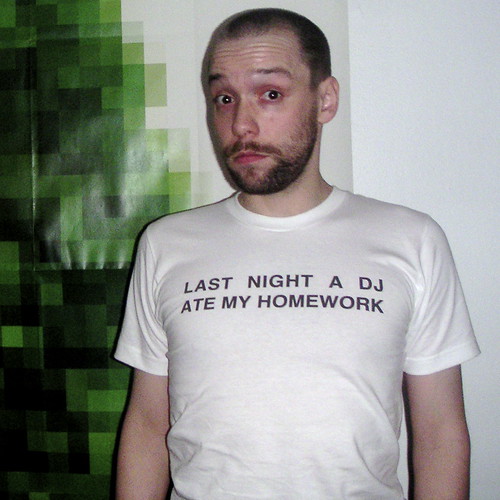
T-Shirt Idea

Okay, actually it was Greg's idea (pictured). Available from Cafepress, natch, where dreams come true.

Thursday, December 6, 2007

Who Blogwatches the Blogwatchmen?

I don't follow Greg Sandow's blog, but I understand there are people who do, so I've always assumed there's something he does right and I'm just missing it. Gramophone cast a little doubt on that assumption this month by selecting for its Blogwatch feature an especially ill-informed and poorly thought-out piece on the music and legacy of Luciano Berio. Sandow's conclusion:

And in Berio's modernism, delightful as it now sounds to me -- and not just delightful; irreverent, too -- you run into a brick wall of limitation. Berio can twitter and burp all he likes, but the connections that he thinks he's making to the world outside classical music are all to highbrow theorizing, cultural, linguistic, and literary. You'd never catch him echoing a snatched memory of popular culture (unless you count folk songs, which I don't, because they're theorized, in Berio's world, as authentic, while pop culture, supposedly, is commercial and corrupt). So that's the boundary. He can giggle all he wants, and also cough and hum and murmur, putting sounds in free association with each other. But if I'd written a piece like this, and my free association took me to a fragment of Led Zeppelin, eyebrows would have been raised. Likewise, when Elliott Carter says that he's inspired (as, for instance, in his piano piece Night Fantasies) by the slither of unconscious thoughts in Joyce's writing, what he'll never do, as thoughts skitter in his music, is let them skitter toward popular culture (by, for instance, echoing a popular song), as Joyce does on just about every page. That's an odd, restrictive limit, typical of modernist music, but not of other modernist art. And it helps explains why modernist music has never had the appeal of modernist literature or painting.

Was somebody asleep at the wheel of the Gramophone? Within two days of this posting, Sandow had already received a reply correcting the basic error of fact underpinning this argument. Berio loved popular music, and his love was reflected in his composition. Commenter John Abbott wrote:

....yet Berio liked jazz, arranged Beatles songs (supposedly also influencing The Beatles prior to Sgt Pepper), and included all sorts of cultural references in works like Sinfonia. I always associate him with Umberto Eco, who loves mixing "highbrow" and "lowbrow" culture.

And Sandow replies:

I'd love to know more about this. I didn't know about the Beatles arrangements! But -- and maybe this is my fault -- I don't remember pop references in "Sinfonia." That Mahler movement, with the singing and speaking voices, struck me, last time I heard it, as quite notably Mandarin in its culture. I most clearly remember the Samuel Beckett text. I love Beckett -- he's one of my cultural touchstones -- but he's certainly not popular culture.

Err, Berio's Beatles arrangements are not exactly a secret; I'm pretty sure they're mentioned right in his New Grove entry. Here's Cathy Berberian singing "Ticket to Ride," three minutes into this clip.

As for pop references in the Sinfonia, yeah, it's your fault. Maybe listen a little closer to the stylings from Rod Swingle and his Swingle Singers, the gang for whom the piece was composed. Their vocal production is not quite as operatic as one might expect in an hommage à Mahler. Another pop-influenced Berio moment that comes to mind: the drumkits and brass hits of Laborintus 2. Great piece! Give it a listen.

Sandow goes on:

And the Beatles -- I've long thought that the interest in them among classical musicians back in the '60s has been misunderstood. For one thing, it didn't last very long. But mainly, people like Bernstein and Ned Rorem liked the Beatles because their songs did the same kind of things (with melodic and harmonic sophistication) that classical music does. So it wasn't that highbrows started liking rock. It was that rock musicians had started moving into classical territory. If Berio had arranged Rolling Stones songs, I'd have granted him a serious interest in rock & roll. Or if all these classical people had gone crazy for The Band, I'd agree that they had some understanding of rock. The Band's music is easily as sophisticated as the Beatles', but the sophistication derives entirely from American roots music, and isn't like to speak to classical music people who don't move easily on the rock side of the fence.

Why all this speculation about what Berio thought of rock? Let's Google "Luciano Berio" and rock; the first hit is Berio's "Comments on rock," excerpted in the anthology The Lennon Companion. A pity to see how much is omitted in this translation, but we get the idea--what does Berio like about rock? Its eclecticism, the simplicity of its materials, and of course the ease with which those materials can be reconfigured to assimilate Beatles-style avant-gardism. Artists mentioned: yes, Zappa and the Beatles, but also the Four Tops, the Grateful Dead and, guess who, the Rolling Stones.

(Non seq.: Find my new favorite Berio anecdote here.

The conversation was a kind of litany containing the great names of twentieth-century composition: Cage, Messiaen, et al. Then Rihm mentioned Sting. Boulez was shocked. Berio told him to go and listen to Sting's latest album, that he might be surprised.

Heh.)

Postscript--

So after seeing Sandow in the Gramophone, I sent another Greg, one of my Gregs, over to check out the post. His response was immediately to dig up an article in which Luciano Berio actively rails against the kind of "enforced ideology" Sandow claims was propagated by "the crowd [Berio] ran with" (nevermind who Berio actually "ran with"):

In 1968, Berio published an essay in the Christian Science Monitor titled "Meditations on a Twelve-Tone Horse." (available for purchase here.) This essay contains the following notorious passage: "Any attempt to codify musical reality into a kind of imitation grammar (I refer mainly to the efforts associated with the Twelve-Tone System) is a brand of fetishism which shares with Fascism and racism the tendency to reduce live processes to immobile, labeled objects, the tendency to deal with formalities rather than substance. Claude Levi-Strauss describes (though to illustrate a different point) a captain at sea, his ship reduced to a frail raft without sails, who, by enforcing a meticulous protocol on his crew, is able to distract them from nostalgia for a safe harbor and from the desire for a destination."

Sandow:

Serialism is taught in music schools these days -- or rather the history of serialism -- with great respect. Certainly it was when I was in music school. Nobody mentioned the derision of intellectuals like Levi-Strauss, which was as legitimate a part of the history as Boulez's excitement.

So true! Errr, except for the parts you misread, misremembered, or just plain made up.

Thursday, August 30, 2007

Lousy Books by Fake People Mystifyingly Popular

Back in spring 2005, one of my Gregs went on record saying that camera-shy publicity hound and autobiographical novelist JT LeRoy was, and I quote, "a total fraud, a fake, an elaborate hoax"; "Fake! Fake! Fake!"; "FFFFAAAAAAAAAAKE." As my fellow schadenfreudeholics will recall--especially if you relished this recent profile of the lovable sociopath behind the "literary" phenom--it was not long afterwards that LeRoy was revealed as a phony, a sham, a counterfeit (definitive coverage here). To which Greg said: "When Augusten Burroughs's nice, well-adjusted, middle-class non-abusive parents get interviewed in the Times, I am buying myself a scotch." Close enough, Greg? It's finally official: Augusten Burroughs is a damned fake. Although I'm still waiting for them to make it official that Augusten Burroughs is vapid, smug and unfunny. How I have shuddered, all these years, to find his stupid, ugly books in the "Favorites" lists of otherwise sane and intelligent-seeming people! This latest link is from Gawker.com, naturally, and as always, their reader comments are delicious. Enjoy.

Friday, August 24, 2007

Cat + Girl = Hilarity

Just to draw the Web of Gregs a little tighter round you-all, let me draw your attention to one of my favorite webcomics, Cat and Girl by Dorothy Gambrell. I've been a faithful reader for some time now, but until this afternoon I never bothered to explore everything that this little website has to offer. Come to find out, it's all incredibly good. In addition to the comics and the inevitable merch table, there's also an elegant blog-cum-travelogue, and best of all, the Donation Derby, a quietly brilliant account of your PayPal dollars at work. I totally want to give her money now, even though I am poor. Everybody go look at it. The only creepy thing is that, yes, I first heard about this comic from one of the Gregs, who went to school with the author--which I guess means that she also went to school with composer Judd Greenstein, bassist Peter Rosenfeld (of Silk Road and NOW Ensembles fame), and one of the Books. That is to say, around fifty percent of the content I've blogged here. Yeesh.

Wednesday, July 18, 2007

Spemalot

Just noticed Monday's fun post at The Overgrown Path, on the subject of oversized choral works. Our Pliable pathster must be delighted to have been proved wrong; he called Alessandro Striggio's 40- and 60-part mass "lost," when really it was just misfiled. The way I heard this story from one of the Gregs, the composer's name had been creatively respelled somewhere along the way (not so unusual), a well-meaning librarian--apparently thinking oh, they must have meant FOUR-part mass--dropped the second digit, and bingo, the piece was totally unfindable, damned to spend a few centuries in storage next to the Ark of the Covenant. Not until just a few years ago did harpsichordist/musicologist Davitt Moroney rescue the score from oblivion, and not until Prom 6, 17 July 2007, did the incomparable Tallis Scholars deliver its first modern performance. Unfortunately, the BBC stream (expiring on the 24th of this month) is a bit strident, so I think I'll hold out for the CD before I give it a good hard listen. Striggio's mass was probably, as M. Pliable observes, a direct forbear to the forty-part Spem in Alium of Thomas Tallis, who is supposed to have been asked, isn't there an Englishman who could write as well as this guy? (Answer: Yes, apparently.) The Path leads us, rightly, towards Paul Van Nevel's excellent Spem for Sony, with his Huelgas Ensemble, on a program (Utopia Triumphans) of gonzo Renaissance polyphony also including Ockeghem's 36-part canon and a 40-part Striggio motet. Incidentally, I just picked up Van Nevel's of a 24-part Annibale Padovano mass the other day the other day (on Harmonia Mundi), and I recommend it highly as well--in addition to just about anything recorded by the Huelgas Ensemble under Paul Van Nevel, a genius for rounding up obscure masterpieces and doing them right on disc. Now that Striggio's lost mass is finally recovered, what will be the next monster of polyphony to show up on CD? Assuming that forty-part Lassus motet stays lost, I vote for the never-recorded, 36-part Moondog canon "Well, Well Dukel." Actually, anybody who reads this, tell me where I can get a score for that mother. I want more Moondog! So much is still unavailable. Did you know he made an album with Julie Andrews?? Seriously. (Totally out of print, of course. Somehody help!) That's it at the top of this post, with the radiant Ms. Andrews in her fairy-tale gown--although perhaps they should have put Moondog on the front, since he was something of a fairy-tale figure himself (that's him in this other picture, with the spear). I think Joseph Campbell was the first to observe that every culture has a story about a blind, busking Viking contrapuntalist on Sixth Ave.

Saturday, July 14, 2007

The End of New Music Part II: Son of New Music

Okay, as promised, here's my thing on the Free Speech Zone tour. First, let me admit my biases: I really like the dudes from the NOW Ensemble. Composer Judd Greenstein went to college with one of my Gregs (also with, by a happy coincidence, one of the Books!), then went to grad school here in town, and I still see him around and everybody loves him. Same story with NOW bassist/sex symbol Peter Rosenfeld! But while I've always been embarrassed that this review never (apparently) made it into print, I hesitated to send it directly to Greenstein and fellow FSZ composer Missy Mazzoli just on account of it's sorta ambivalent. This has caused me to act really awkward whenever I see them, as in the following exchange from a merch table at this year's 26-hour Bang on a Can Marathon:
MM: "Hey!" DSJ: "Uh, hey!" [Thinking, Is that Missy Mazzoli?] MM: "Remember me?" DSJ [unconvincingly]: "Of course!" [That is Missy, right? But the lighting's kind of off in here, and I haven't seen her in a while, and isn't her hair different, and what if it's not Missy and I say "Missy!"?] MM: "It's me, Missy!" DSJ: "Of course!" [Oh dammit, I have that breakfast date scheduled for the exact same time as her piece is getting played.] MM: "How are you?" DSJ: "I'm going to miss your piece!" MM [slightly baffled]: "Oh!" DSJ: "People do have to sleep and eat, you know! Ha ha!"

So yeah, I thought I came off well. Anyway, here is that Free Speech Zone review, which I still pretty much stand behind, newspaper-y prose notwithstanding, although... one more disclosure: Firehouse 12 is an intimate, acoustically flawless venue (the Mates of State record there!) with a bar that, if you ask for a martini, hands you something that looks like a fishbowl with a stem on it. Long story short, by the time this concert was over I was feelin' some martini, so hopefully my aesthetic judgment was not as clouded as the judgment that would have stopped me from saying omg I'm so TIPSY with NOW Ensemble's Mark Dancigers sitting right next to me. Anyhow--

COMMON GROUND You say "preaching to the choir" like it's a bad thing. I'm suspicious of political art, as a rule. What's the point of a piece of classical music on political themes? Did a string quartet ever inspire someone to vote Democratic? Or is the act of composing political music merely therapeutic? I asked these questions Saturday night--before the Free Speech Zone Tour played to a packed house at Firehouse 12--and I left with a few more answers than I'd expected to. Named after tour co-organizer Judd Greenstein's piece on the program (named, in turn, after the corrals to which our President exiles all dissent at public appearances), Free Speech Zone paired young, left-wing new music groups NOW Ensemble (formerly of New Haven) and Newspeak in an evening of amplified protest. The concert opened with the setting of an unfortunate text: excerpts from Sam Smith's "Apology to Younger Americans," an essay listing Smith's regrets "on behalf of all my fellow members of America's crummiest generation." I wasn't impressed when I encountered the "Apology" as an email forward, and I was all the more dismayed to hear it sung aloud. Former Green alderman and Yale assistant professor of music John Halle's introductory remarks, dedicating his piece to the young NOW Ensemble, were genuinely touching, and his seamless writing made the most of the material. But when the words "Bill O'Reilly" are sung by an operatic soprano (the excellent Bo Chang--expressive and articulate, though seemingly unused to a microphone), something has gone wrong. Patrick Burke's contribution, External Forces, started promisingly--with the weird, unpolished sound of vocal humming from the instrumentalists. The piece attempted to describe the corruption of stable conditions by outside agents, but the chipper melody that emerged, as well as its interruption by crashing dissonances, were disappointingly obvious. The "breakdown" rang false, and when we finally retreated back to that eerie humming, it too had become a gimmick. Part of the difficulty of writing for the NOW Ensemble must have to do with its eccentric, Bang on a Can-inspired lineup: guitar, standup bass, piano, flute, clarinet. When the sonorities of the piece were pure and light, these instruments sang together like a choir, but when the rhythm section decided to rock out, the flute and clarinet were unable to join them. Greenstein's Free Speech Zone was the most affecting piece on the program, though accompanied by an undistinguished video presentation. The composer introduced his work wearing a t-shirt reading COMMON (as in the rapper); according to his bio, "Judd's music blends Romanticism and post-minimalist harmonic and textural elements with a strong grounding in hip hop, rock, and electronic dance music"--but that's got it backwards. While the textures of the piece occasionally turned jazzy, a pulsing/strumming figure embedded between polyrhythmic strata, the foundation was unmistakably classical. The instrumentation of the piece was convincing not because Greenstein had found some place for the woodwinds within a popular idiom, but because the winds' Stravinskian outbursts and sinuous lyricism were already at home in a music saturated with early 20th-cenury influences. *** After an intermission, Newspeak launched directly into director David T. Little's ferocious Electric Proletariat, a showcase for their unique virtuosity. This band's lineup was more inherently versatile than NOW Ensemble's, replacing the flute and bass with brutal violin and cello fiddling (amplified for most of their set) and adding a drummer and a percussionist for even more edge. Daisy Press, the group's vocalist, came on for Keeril Makan's song cycle Target, based on overwrought verses by Jena Osman ("It seems to be moving," went one line, "like a body made of parts." What?). The setting did not impress, but the performers made the most of the score's best trick: pairing sounds from the vocal line with close imitations from the ensemble. Press's near-oracular performance was half rock star (she definitely knew how to use a microphone), half new-music diva, and the instrumentalists' ability to take their cues from the back of her wild hairdo was miraculous. The last two pieces on the program cemented the overall tone. The closer, a cover of "War Pigs" by Black Sabbath, was tight, loud, and exhilarating (though Press's intonation wavered); the penultimate piece, Missy Mazzoli's lovely and hopeful In Spite of All This--the strings "unplugged" for a little while--underlined the evening's essential purpose. Yes, it was a "merely" therapeutic performance. But it was consoling for the audience as well--a sorely needed moment of community in dark political times.

Saturday, May 26, 2007

SPOON BOX!

Get into the Books. They have a new DVD--PLAYALL--for sale on their website, they're going to be playing a free set at this year's massive Ban on a Can Marathon (alongside such other awesomenesses as Juana Molina, Yo La Tengo, and many, many, many more), and their '05 record Lost & Safe has some of the most ingenious uses of found sound I've ever heard in music. But most importantly, they have created... the Spoon Box: The Spoon Box uses two speakers emitting low-frequency sound to make a pair of ordinary measuring spoons bounce up and down on columns of air. The piece playing on the Spoon Box in this clip also samples everyday kitchen noises so that the spoons won't feel out of place. You can even order your own Spoon Box from the Books website, and wow visitors to your home with the power of sound. Spoon Box.

Nun of the Above

On my way to her first opera,  Hildegard,  on Friday night, I was thinking again about Sarah Kirkland Snider’s music, and how I might descri...